What Is a Clearinghouse in Medical Billing? Guide for Providers and Billers

A clearinghouse in medical billing is one of the most important parts of the revenue cycle because it sits between the healthcare provider and the insurance payer. Instead of sending claims one by one to every insurance company in different formats, providers usually send their claims to a clearinghouse first. The clearinghouse reviews the claim, checks it for common errors, reformats it when needed, and then forwards it to the correct payer. This process helps practices submit cleaner claims, reduce avoidable errors, and improve reimbursement speed. Many people ask what is a clearinghouse in medical billing or what does clearinghouse mean in medical billing because the term sounds technical. In simple words, a clearinghouse is a digital middleman that helps medical claims move safely and accurately from the provider’s billing system to the insurer. It does not replace the payer, and it does not make the final payment decision. Its role is to review, validate, and route claims so they reach the payer in the correct format with fewer errors.
What Is a Clearinghouse in Medical Billing
If someone asks what is a clearinghouse in medical billing, the simple answer is that it is an electronic intermediary that reviews, edits, and routes medical claims. It receives claim files from a practice management system or EHR, checks them for common mistakes, and converts them into the format required by the payer before submission. In short, it helps providers send claims more accurately and efficiently.
Schedule Your Free Consultation
Clearinghouse Definition in Medical Billing
The clearinghouse definition in medical billing can be understood as a digital claim-processing partner that standardizes communication between providers and payers. A clearinghouse is not the insurance company and it does not decide whether a claim will be paid. Its job is to validate and transmit healthcare transactions such as claims, remittances, eligibility checks, and claim status messages so the payer receives usable data.
What Is Clearinghouse in Medical Billing
If someone asks what is clearinghouse in medical billing, the best answer is that it is an electronic transaction hub used to process healthcare claims and related billing data. A clearinghouse accepts claim files from provider offices, hospitals, or billing companies, checks them against payer rules and HIPAA transaction standards, flags problems, and submits accepted claims to insurance companies or government programs like Med Bill Ultra and Medicaid. This improves accuracy and keeps the billing workflow organized. The clearinghouse definition in medical billing can also be understood through its daily tasks. It validates patient and provider information, checks formatting, confirms required fields are present, identifies obvious coding or demographic mistakes, and returns rejected claims for correction before those claims become payer denials. That is why clearinghouses are often connected with claim scrubbing, eligibility transactions, electronic remittance advice, claim status updates, and attachments.
What Is the Purpose of a Clearinghouse in Medical Billing
The answer to what is the purpose of a clearinghouse in medical billing is straightforward: it helps providers send clean claims faster and with less manual work. A strong clearinghouse reduces claim errors before submission, standardizes electronic data exchange, supports compliance, and gives billing teams better visibility into claim status. This directly affects cash flow because fewer preventable mistakes mean fewer delays in payment. Another major purpose is efficiency. Instead of managing separate claim rules, portals, and formats for many payers, a provider can use one clearinghouse connection to reach a broad network. That saves staff time and reduces the administrative burden on front-desk, coding, and billing teams. The AMA also notes that practices must monitor payer decisions after claims are submitted, and clearinghouse workflow is a key part of that ongoing revenue cycle process.
How a Clearinghouse in Medical Billing Works
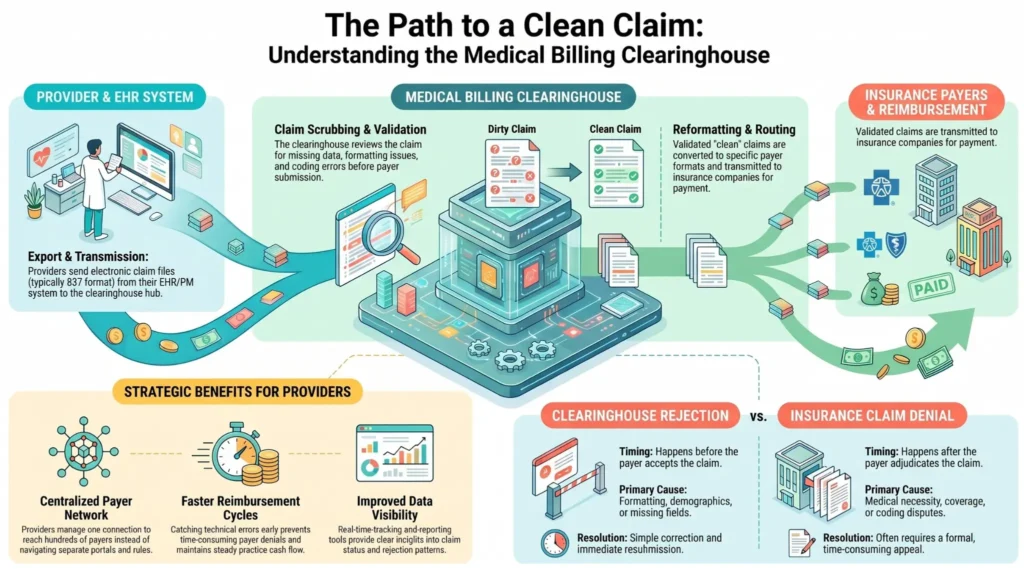
The workflow begins when the provider creates a claim from the EHR or practice management system. The claim is sent electronically to the clearinghouse, often in an 837 transaction format. The clearinghouse then performs edits and validation checks. If the claim passes, it is transmitted to the payer. If it fails, it is returned to the provider or biller with error details so corrections can be made before resubmission. This is why clearinghouses are so valuable in daily billing. They do not just move files from one place to another. They actively improve the quality of the submission process. Some clearinghouses also support eligibility checks, claim status inquiries, authorizations, remittance posting, attachments, analytics, and denial-prevention tools. In practical terms, that means a provider gets one central place to manage more of the billing cycle.
How to Choose the Right Clearinghouse in Medical Billing
Choosing the right clearinghouse in medical billing depends on your operational needs. A small private practice may prioritize simple pricing, easy claim edits, and responsive support. A hospital system may care more about enterprise integration, large payer networks, analytics, advanced edits, attachment workflows, and strong automation. The ideal solution is not always the biggest brand. It is the one that fits your volume, specialties, payer mix, and internal workflow. When comparing vendors, look at payer coverage, ease of integration with your EHR or PM software, claim edit quality, reporting tools, training, customer support, remittance capabilities, and denial-prevention features. A clearinghouse that only transmits claims is useful, but a clearinghouse that helps you prevent errors, track statuses, and improve your clean claim rate can create much more long-term value.
What Does Clearinghouse Mean in Medical Billing
When people ask what does clearinghouse mean in medical billing, they usually want a plain-language explanation. It means a system that catches claim problems before the payer sees them. If the claim has invalid insurance details, missing provider data, or formatting problems, the clearinghouse can stop it and send it back for correction. That is why clearinghouses are often associated with “claim scrubbing,” faster submissions, and fewer preventable payment delays.
Why Clearinghouses Matter in the Revenue Cycle
Clearinghouses matter because they sit at a critical point in the revenue cycle where many claim problems can still be fixed quickly. A good clearinghouse reduces the chance that claims will be delayed by technical issues, missing data, or formatting problems. It also gives billing teams better visibility into claim flow, which supports quicker follow-up and better cash flow management.
Benefits of Using a Clearinghouse in Medical Billing
Using a clearinghouse can improve workflow in several ways. It centralizes eligibility, claims, and remits; reduces repetitive manual tasks; helps prevent simple submission mistakes; and supports faster correction of errors. Modern clearinghouses also offer analytics, reporting, and automation tools that help practices monitor performance and improve their clean-claim rate over time.
List of Clearinghouses in Medical Billing
When people search for a list of clearinghouses in medical billing, they are usually trying to compare vendors for usability, payer reach, integrations, and claim-editing strength. The names above are among the most recognized options in current provider workflow discussions, but the “best” choice depends on practice size, specialty, transaction volume, existing EHR integrations, and customer-support needs.
Clearinghouse Rejections in Medical Billing
Clearinghouse rejections in medical billing happen before the claim fully enters payer adjudication. That means the claim was stopped due to data-entry errors, formatting issues, missing information, or failure to meet payer or X12 requirements. Rejections are different from denials because the claim is not yet accepted as a processable billable claim by the payer.
Common Causes of Clearinghouse Rejections in Medical Billing
Common rejection causes include invalid subscriber information, missing required fields, incorrect patient demographics, invalid modifiers, incomplete coordination-of-benefits details, and technical formatting errors. Med Bill Ultra and CareCloud both note that these technical and data-quality issues can interrupt the claim before it proceeds, which is why front-end accuracy and claim validation matter so much.
How to Fix Clearinghouse Rejections in Medical Billing
The best way to fix a rejection is to review the rejection report carefully, correct only the flagged data, validate the claim again, and resubmit it quickly. Billing teams should not ignore rejections because even technical errors can become true denials if timely-filing windows are missed. Regular review of clearinghouse reports and stronger data-entry controls can greatly reduce repeated rejection patterns.
Difference Between Clearinghouse Rejections and Claim Denials
A rejection usually happens before the payer fully accepts the claim for processing, while a denial happens after the claim reaches the payer and is adjudicated but not paid as submitted. In practical billing terms, rejections are usually faster to fix because the claim can be corrected and resent without formal appeal steps. Denials are often more time-consuming because they may involve medical necessity, coverage, authorization, coding, or documentation disputes.
Final Thoughts on What Is a Clearinghouse in Medical Billing
A clearinghouse is more than a claim-transmission tool. It is a quality-control checkpoint that helps providers send cleaner claims, reduce avoidable errors, and manage billing work more efficiently. So, if someone asks what is clearinghouse in medical billing, what does clearinghouse mean in medical billing, or what is the purpose of a clearinghouse in medical billing, the best answer is this: it is a core revenue-cycle partner that helps claims move from provider to payer accurately, securely, and with fewer delays.

Higher Approvals, Faster Payouts: Specialized Chiropractic Billing

Error-Free Pediatric Billing: Maximize Practice Reimbursements
You Might Also Like

Higher Approvals, Faster Payouts: Specialized Chiropractic Billing

Error-Free Pediatric Billing: Maximize Practice Reimbursements