
Why Emergency Medicine Practices Need Regular Medical Billing Audits?
Medical billing audit services play a critical role in helping emergency medicine practices maintain financial stability, improve compliance, and maximize revenue. Emergency departments operate in a fast-paced environment where physicians treat a high volume of patients with varying levels of care complexity. This creates numerous billing challenges that can lead to coding errors, claim denials, revenue leakage, and compliance risks. Regular medical billing audits provide healthcare organizations with the insights needed to identify billing inaccuracies, optimize reimbursement processes, and ensure adherence to payer regulations. As healthcare regulations continue to evolve, emergency medicine practices must prioritize billing accuracy to protect their revenue and reputation. This article explores why emergency medicine providers need regular billing audits and how partnering with a trusted medical billing audit company can strengthen financial performance and operational efficiency.
Medical Billing Audits in Emergency Medicine
A medical billing audit is a systematic review of billing records, coding practices, claim submissions, and reimbursement processes. The goal is to identify errors, inconsistencies, compliance issues, and missed revenue opportunities.
Emergency medicine presents unique billing challenges because providers often manage:
- High patient volumes
- Complex coding requirements
- Multiple insurance carriers
- Time-sensitive treatments
- Frequent regulatory updates
- Variable levels of patient acuity
Regular medical billing auditing helps practices ensure that claims accurately reflect services rendered and comply with payer guidelines.
Contact Us
The Financial Impact of Billing Errors
Medical billing audits are essential because even minor coding mistakes can have significant financial consequences. Errors in emergency medicine billing may result in:
- Underpayments from insurance companies
- Delayed reimbursements
- Increased claim denials
- Lost revenue opportunities
- Compliance penalties
Emergency physicians often provide critical care, observation services, diagnostic evaluations, and procedures during a single patient encounter. Incorrect coding of any service can lead to substantial reimbursement losses. A professional medical billing auditing company can identify patterns of revenue leakage and implement corrective measures that improve collections and cash flow.
Reducing Claim Denials and Rejections
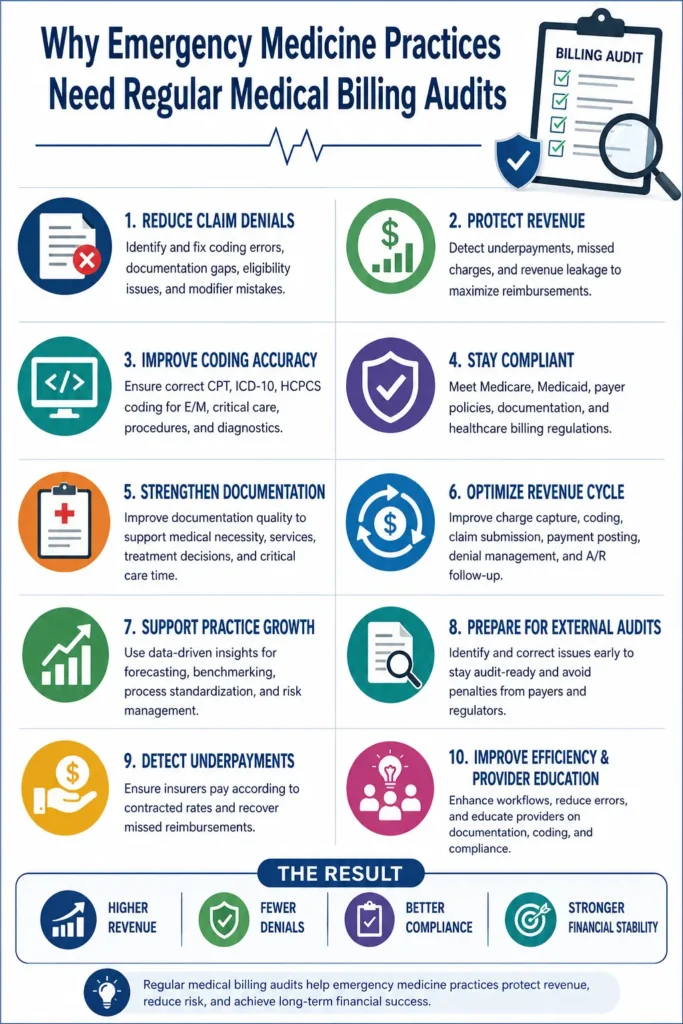
Medical billing audit services help emergency medicine practices reduce claim denials by identifying the root causes of billing issues.
Common denial reasons include:
Incorrect Coding
Using outdated or inaccurate CPT, HCPCS, or ICD-10 codes can trigger claim rejections.
Missing Documentation
Incomplete clinical documentation often prevents payers from validating billed services.
Eligibility Errors
Incorrect patient insurance information can lead to claim denials before processing even begins.
Modifier Issues
Improper use of billing modifiers frequently affects emergency department reimbursements.
By conducting regular medical billing audits, practices can identify recurring denial trends and improve claim accuracy before submission.
Ensuring Compliance with Healthcare Regulations
Medical billing audit companies play an important role in maintaining compliance with federal and payer regulations.
Healthcare organizations must comply with numerous requirements, including:
- Medicare billing guidelines
- Medicaid regulations
- Commercial payer policies
- Documentation standards
- Coding compliance requirements
Failure to meet these standards can result in audits, penalties, fines, and reputational damage. A qualified medical billing audit company evaluates coding accuracy, documentation quality, and billing procedures to ensure compliance with current regulations.
Improving Coding Accuracy
Medical billing auditing is particularly valuable in emergency medicine because coding complexity continues to increase.
Emergency department coding often involves:
- Evaluation and management services
- Critical care coding
- Observation services
- Procedures and interventions
- Diagnostic testing
- Trauma cases
Accurate coding directly impacts reimbursement levels. Under-coding reduces revenue, while over-coding increases compliance risks. Regular reviews conducted by a medical billing auditing company help providers maintain coding accuracy and achieve appropriate reimbursement for services delivered.
Identifying Revenue Leakage
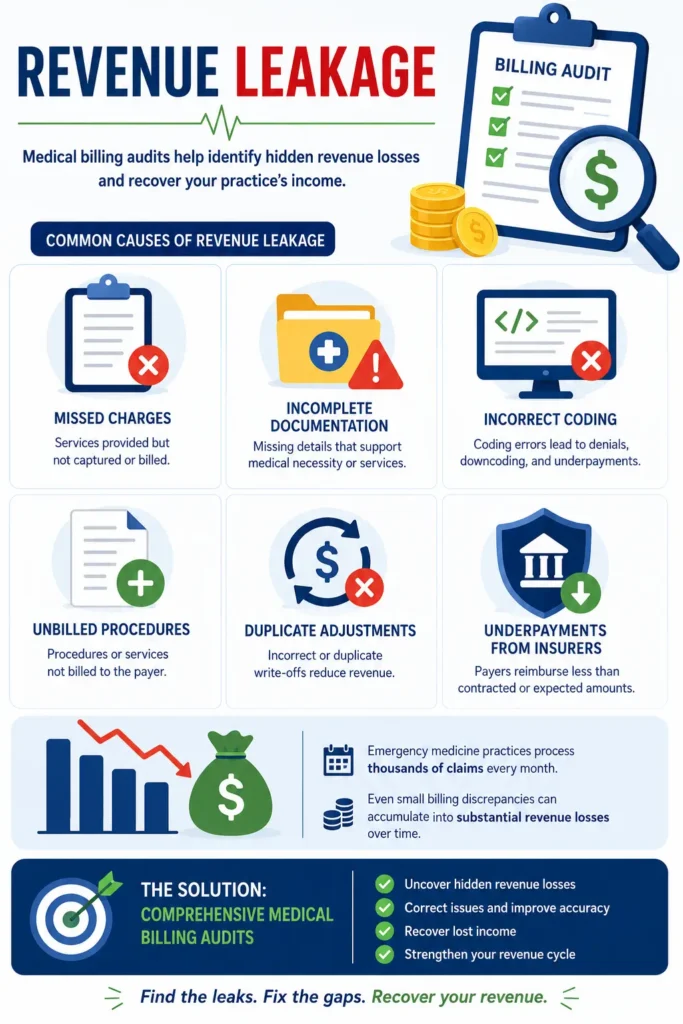
One of the primary goals of medical billing audit services is identifying hidden revenue losses.
Revenue leakage can occur due to:
- Missed charges
- Incomplete documentation
- Incorrect coding
- Unbilled procedures
- Duplicate adjustments
- Underpayments from insurers
Emergency medicine practices often process thousands of claims each month. Even small billing discrepancies can accumulate into substantial revenue losses over time. A comprehensive medical billing audit service helps uncover these issues and recover lost income.
Enhancing Documentation Quality
Medical billing audits frequently reveal gaps between clinical documentation and submitted claims.
Documentation should clearly support:
- Medical necessity
- Services performed
- Patient condition
- Treatment decisions
- Critical care time
- Procedures provided
Insufficient documentation increases the likelihood of denials and payer audits. Regular auditing encourages physicians and staff to improve documentation practices, creating stronger support for reimbursement claims.
Strengthening Revenue Cycle Management
Medical billing audit services contribute significantly to revenue cycle optimization.
The revenue cycle includes:
- Patient registration
- Insurance verification
- Charge capture
- Medical coding
- Claim submission
- Payment posting
- Denial management
- Accounts receivable follow-up
A detailed medical billing audit examines each stage of the revenue cycle to identify inefficiencies and performance gaps. Improved processes result in faster reimbursements, reduced denials, and healthier cash flow.
Supporting Practice Growth
As emergency medicine groups expand, billing complexity increases. New providers, additional locations, and growing patient volumes create greater opportunities for billing inconsistencies. Partnering with experienced medical billing audit companies allows practices to scale confidently while maintaining financial control.
Regular audits provide:
- Performance benchmarking
- Revenue forecasting insights
- Compliance monitoring
- Process standardization
- Risk management support
These benefits help practices sustain growth without compromising billing quality.
Detecting Underpayments from Insurance Companies
Many emergency medicine practices focus primarily on claim denials but overlook payer underpayments. Medical billing auditing companies often discover situations where insurers reimburse less than contracted rates.
Underpayments may result from:
- Fee schedule discrepancies
- Contract interpretation issues
- Coding misunderstandings
- Payment processing errors
Without regular reviews, these underpayments may go unnoticed for months or years. A professional medical billing audit service ensures that payers fulfill their contractual reimbursement obligations.
Preparing for External Audits
Healthcare organizations may face audits from:
- Medicare
- Medicaid
- Commercial insurance carriers
- Regulatory agencies
Regular internal medical billing audits help practices prepare for these external reviews. By identifying and correcting deficiencies proactively, organizations reduce the likelihood of penalties and repayment demands. A reputable medical billing audit company can also provide recommendations that strengthen audit readiness and compliance programs.
Improving Operational Efficiency
Medical billing auditing extends beyond financial reviews. It also helps identify workflow inefficiencies that affect billing performance.
Common operational challenges include:
- Delayed charge entry
- Inconsistent coding practices
- Communication gaps between providers and billers
- Insufficient staff training
- Outdated billing procedures
Addressing these issues improves productivity while reducing administrative burdens.
Increasing Provider Education
One overlooked benefit of medical billing audit services is provider education. Audit findings often reveal opportunities for physicians to improve:
- Documentation habits
- Coding awareness
- Compliance understanding
- Charge capture accuracy
Ongoing education creates stronger alignment between clinical care and billing requirements. As a result, providers become more engaged in revenue cycle success.
Choosing the Best Medical Billing Audit Partner
Selecting the best medical billing audit provider is essential for achieving meaningful results.
When evaluating audit partners, consider:
Industry Experience
Choose a company with extensive emergency medicine billing expertise.
Compliance Knowledge
The provider should understand current healthcare regulations and payer requirements.
Detailed Reporting
Comprehensive audit reports should clearly identify errors, trends, and improvement opportunities.
Conclusion
Medical billing audit services are no longer optional for emergency medicine practices seeking financial stability and regulatory compliance. The complexity of emergency department billing creates numerous opportunities for coding errors, denied claims, revenue leakage, and compliance risks. Regular medical billing audits help organizations improve coding accuracy, reduce denials, strengthen documentation, identify underpayments, and optimize revenue cycle performance. Whether performed internally or through experienced medical billing audit companies, ongoing audits provide the transparency and accountability needed to support long-term success. By partnering with a trusted medical billing audit company, emergency medicine practices can protect revenue, enhance compliance, and deliver sustainable financial growth in an increasingly complex healthcare environment.
Latest News

Get Enrolled Faster: Expert Provider Credentialing & Enrollment Services
September 29, 2026
No Comments
Read More »

You Might Also Like

Never Miss a Patient: 24/7 Virtual Front Desk Management Services
September 30, 2026
No Comments
Read More »

Get Enrolled Faster: Expert Provider Credentialing & Enrollment Services
September 29, 2026
No Comments
Read More »


Top Medical Billing Services in USA | Revenue Cycle Management (RCM)
September 24, 2026
No Comments
Read More »
