How Electronic Prior Authorization Update Medical Billing?
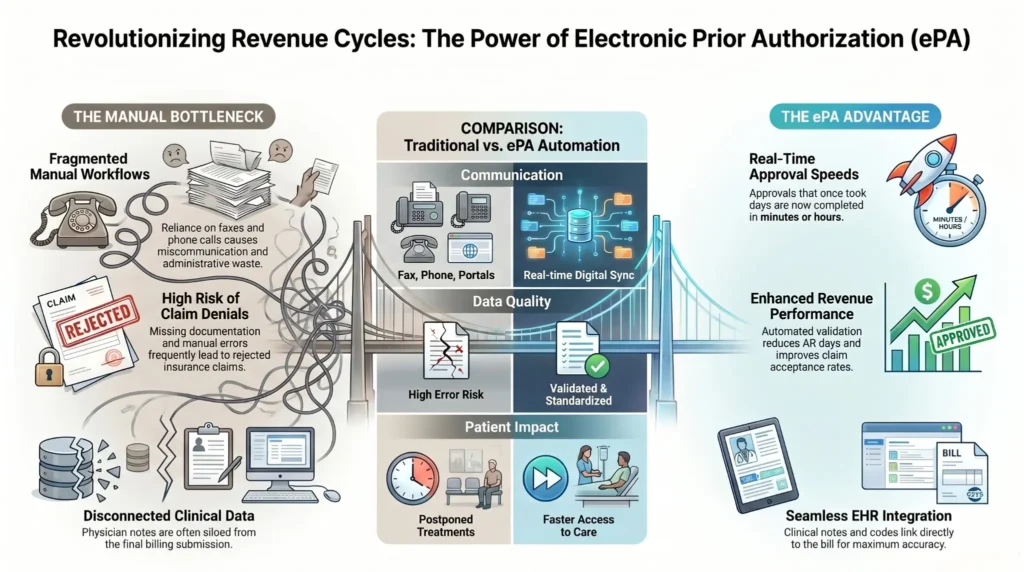
Electronic Prior Authorization simplifies one of the most time-consuming processes in the revenue cycle. Traditionally, staff had to submit authorization requests via fax, phone calls, or payer portals leading to delays, errors, and miscommunication. With ePA, requests are submitted digitally in real-time, allowing faster approvals and better tracking. This automation reduces the risk of missing documentation and confirms that billing teams receive accurate authorization data before claim submission. As a result, providers experience fewer denials, improved claim acceptance rates, and faster reimbursements.
Understanding Electronic Prior Authorization (ePA)?
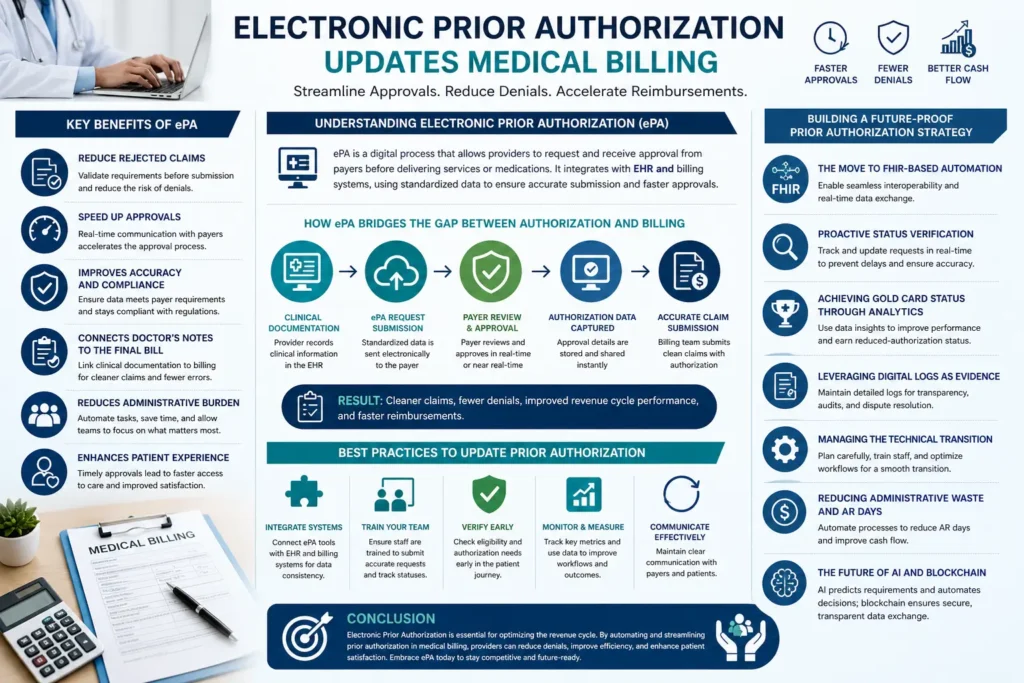
Electronic Prior Authorization (ePA) is a digital process that allows healthcare providers to request and receive approval from insurance payers before delivering specific services or medications. It integrates directly with Electronic Health Records (EHR) and billing systems, enabling seamless communication between providers and insurers. Unlike traditional methods, ePA uses standardized data formats, confirming that all required clinical and billing information is submitted correctly the first time. This not only speeds up approvals but also improves documentation quality an essential factor in successful medical billing.
Schedule Your Free Consultation
Best Practices to Update Prior Authorization
To fully leverage Electronic Prior Authorization, healthcare organizations must adopt best practices that align clinical workflows with billing operations. Start by integrating ePA tools with your EHR and billing systems to confirm data consistency. Staff training is equally important teams must understand how to submit accurate requests and track authorization statuses efficiently. Another key strategy is to verify insurance eligibility and authorization requirements early in the patient journey. This proactive approach prevents last-minute surprises and confirms that all services are pre-approved before billing begins.
How ePA Bridges the Gap Between Authorization and Billing?
Electronic Prior Authorization plays a crucial role in connecting clinical decision-making with financial outcomes. By confirming that approvals are obtained and documented before services are rendered, ePA eliminates the disconnect between authorization and billing teams. This alignment leads to cleaner claims, reduced rework, and improved revenue cycle performance. It also confirms that billing teams have immediate access to authorization details, which are essential for accurate claim submission.
Reduce Rejected Claims
One of the biggest challenges in prior authorization in medical billing is claim rejection due to missing or incorrect authorization. Electronic Prior Authorization minimizes this risk by validating requirements before submission. Automated checks confirm that all necessary information is included, significantly reducing the chances of denial. With fewer rejected claims, billing teams spend less time on rework and appeals, allowing them to focus on more strategic tasks.
Speed Up Approvals
Speed is a critical factor in healthcare operations. Electronic Prior Authorization accelerates the approval process by eliminating manual steps and enabling real-time communication with payers. Many approvals that previously took days can now be completed within minutes or hours. Faster approvals mean quicker service delivery, improved patient satisfaction, and a more efficient billing cycle.
Improves Accuracy and Compliance
Accuracy is essential in both clinical documentation and billing. Electronic Prior Authorization confirms that all submitted data meets payer requirements, reducing errors and improving compliance with regulations. Standardized workflows and automated validation checks help maintain consistency across all authorization requests. This not only improves claim success rates but also protects providers from compliance risks.
Connects the Doctor’s Notes to the Final Bill
A major advantage of Electronic Prior Authorization is its ability to link clinical documentation directly to billing data. Physician notes, diagnosis codes, and treatment plans are automatically included in the authorization request, certifying that billing teams have access to complete and accurate information. This connection eliminates discrepancies between clinical and financial records, resulting in cleaner claims and faster reimbursements.
Reduces Administrative Burden
Manual prior authorization processes require significant time and effort from administrative staff. Electronic Prior Authorization reduces this burden by automating repetitive tasks such as data entry, status tracking, and follow-ups. By freeing up staff resources, healthcare organizations can focus on patient care and strategic initiatives rather than administrative work.
Enhances Patient Experience
Delays in authorization can lead to postponed treatments and frustrated patients. Electronic Prior Authorization improves the patient experience by confirming timely approvals and reducing waiting times. Patients benefit from faster access to care, fewer billing issues, and greater transparency in the approval process.
Building a Future-Proof Prior Authorization Strategy
As healthcare continues to evolve, organizations must adopt forward-thinking strategies to stay competitive. Implementing Electronic Prior Authorization is a key step toward building a future-proof revenue cycle. This involves investing in advanced technologies, optimizing workflows, and continuously monitoring performance metrics to identify areas for improvement.
The Move to FHIR-Based Automation
Fast Healthcare Interoperability Resources (FHIR) is revolutionizing data exchange in healthcare. By adopting FHIR-based automation, Electronic Prior Authorization systems can achieve seamless interoperability between providers, payers, and technology platforms. This enables real-time data sharing, improved accuracy, and faster decision-making key factors in efficient medical billing.
Proactive Status Verification
Proactive status verification confirms that authorization requests are tracked and updated in real-time. Electronic systems provide visibility into the status of each request, allowing teams to address issues before they impact billing. This proactive approach reduces delays and confirms that claims are submitted with complete and accurate authorization data.
Achieving Gold Card Status Through Analytics
Some payers offer “Gold Card” status to providers with a history of accurate and compliant authorization submissions. By leveraging analytics, healthcare organizations can identify patterns, improve performance, and qualify for this status. Gold Card status reduces the need for prior authorization in certain cases, further streamlining the billing process.
Leveraging Digital Logs as Evidence
Electronic Prior Authorization systems maintain detailed digital logs of all transactions. These logs serve as valuable evidence in case of disputes or audits, confirming transparency and accountability. Having access to complete records helps providers resolve issues and maintain compliance with payer requirements.
Managing the Technical Transition
Transitioning to Electronic Prior Authorization requires careful planning and execution. Organizations must confirm that their systems are compatible, staff are trained, and workflows are optimized. While the initial investment may seem significant, the long-term benefits improved efficiency, reduced denials, and faster reimbursements far outweigh the costs.
Reducing Administrative Waste and AR Days
Accounts Receivable (AR) days are a key performance indicator in medical billing. Electronic Prior Authorization helps reduce AR days by confirming that claims are processed quickly and accurately. By eliminating administrative waste and improving workflow efficiency, organizations can achieve faster revenue cycles and better financial performance.
The Future of AI and Blockchain
The future of Electronic Prior Authorization lies in advanced technologies such as Artificial Intelligence (AI) and blockchain. AI can analyze data patterns to predict authorization requirements and automate decision-making, while blockchain confirms secure and transparent data exchange. These innovations have the potential to further modernize prior authorization in medical billing, making the process faster, more accurate, and more reliable.
Conclusion
Electronic Prior Authorization is no longer optional it is essential for modern healthcare organizations aiming to optimize their revenue cycle. By automating and streamlining prior authorization in medical billing, providers can reduce denials, improve efficiency, and enhance patient satisfaction. From faster approvals to better compliance and reduced administrative burden, the benefits of ePA are undeniable. As technology continues to evolve, organizations that embrace Electronic Prior Authorization will be better positioned to succeed in an increasingly competitive healthcare landscape.

Higher Approvals, Faster Payouts: Specialized Chiropractic Billing

Error-Free Pediatric Billing: Maximize Practice Reimbursements
You Might Also Like

Higher Approvals, Faster Payouts: Specialized Chiropractic Billing

Error-Free Pediatric Billing: Maximize Practice Reimbursements

