Behavioral Health Overlay Services Fee Schedule 2026 for Medicaid in Florida

How Billing Errors Reduce OB/GYN Revenue
OB/GYN practices, even minor billing inaccuracies can quickly translate into significant financial losses. Errors such as incorrect patient information, mismatched codes, or incomplete documentation disrupt the reimbursement cycle and delay payments. Unlike other specialties, OB/GYN billing often involves bundled services, global maternity packages, and time-sensitive care, which increases the margin for error. When these issues occur repeatedly, they create a pattern of revenue leakage that weakens the financial stability of the practice. Over time, consistent billing errors not only reduce immediate cash flow but also increase administrative workload, making it harder for teams to focus on patient care and operational efficiency.
The Hidden Cost of Low Clean Claim Rates
A low clean claim rate is one of the most overlooked issues in OB/GYN revenue cycle management. Clean claims are those submitted without errors and accepted on the first pass by payers. When the clean claim rate drops, practices experience delays, rework, and increased denial rates. Each rejected or denied claim requires additional staff time to correct and resubmit, increasing operational costs. Moreover, delayed reimbursements can disrupt cash flow cycles, making it difficult for practices to manage expenses effectively. Improving clean claim rates is not just about faster payments; it is about reducing friction across the entire billing process.
Schedule Your Free Consultation
Compound Financial Friction
Financial friction occurs when multiple small inefficiencies compound into larger revenue problems. In OB/GYN billing, this can include delays in eligibility verification, coding inaccuracies, missed charges, and slow follow-ups on denied claims. Each of these issues alone may seem manageable, but together they create a bottleneck that restricts revenue flow. Over time, this friction reduces profitability and increases the risk of uncollected revenue. Practices must identify and eliminate these inefficiencies to maintain a smooth and predictable revenue cycle.
Common Gaps Causing Irrecoverable Loss
Irrecoverable losses often stem from gaps in billing processes that go unnoticed until it is too late. These include missed charges for procedures, incorrect use of modifiers, failure to bill separately for complications, and lack of timely claim submission. In OB/GYN practices, where services are often bundled, missing even a single billable component can lead to permanent revenue loss. Additionally, poor documentation can result in claims being denied without the possibility of appeal. Addressing these gaps requires a proactive approach, including regular audits and staff training.
Mismanagement of the Global Maternity Package
The global maternity package is a cornerstone of OB/GYN billing, covering prenatal visits, delivery, and postpartum care. However, mismanagement of this package is a common source of revenue leakage. Errors often occur when services that fall outside the global package are not billed separately or when the timeline of services is not properly tracked. For example, complications during pregnancy or additional procedures may qualify for separate reimbursement, but without proper documentation and coding, these opportunities are lost. Effective management of the global maternity package requires a clear understanding of payer guidelines and meticulous tracking of services.
Financial Impacts of Global Billing Gaps
When gaps occur in global billing, the financial impact can be substantial. Practices may underbill for services provided or fail to capture additional revenue from complications and non-routine care. These gaps not only reduce immediate revenue but also affect long-term financial planning. Consistent underbilling can distort financial reports, making it difficult to assess the true performance of the practice. Addressing these gaps confirms that all services are accurately captured and reimbursed.
The High-Risk Billing Upside
While OB/GYN billing presents challenges, it also offers opportunities for revenue optimization. High-risk cases, such as complicated pregnancies or emergency procedures, often involve additional billable services. When properly documented and coded, these cases can significantly increase revenue. However, they also carry a higher risk of denial if not handled correctly. Practices must balance the opportunity for increased revenue with the need for accuracy and compliance.
Denials in Postpartum Care Recovery
Postpartum care is an essential component of OB/GYN services, yet it is often a source of denied claims. Denials may occur due to incomplete documentation, incorrect coding, or misunderstanding of what is included in the global package. Recovering revenue from these denials requires a structured approach, including timely follow-ups and detailed documentation. Practices that actively manage postpartum billing can reduce denial rates and improve overall revenue recovery.
Strategic Framework for Optimizing OB/GYN Revenue Cycles
Optimizing the revenue cycle in OB/GYN practices requires a strategic and systematic approach. This includes improving front-end processes, confirming accurate coding, and implementing effective denial management strategies. By addressing each stage of the revenue cycle, practices can reduce errors, improve efficiency, and maximize reimbursements. A well-structured framework not only enhances financial performance but also supports long-term growth.
Confirm Front End Accuracy and Pre-Visit Verification
Front-end processes play a critical role in preventing billing errors. Accurate patient information, insurance verification, and eligibility checks must be completed before the patient visit. Errors at this stage can lead to claim rejections and delays in payment. Implementing standardized workflows and using automated verification tools can significantly improve accuracy and efficiency. By confirming that all information is correct from the start, practices can reduce the risk of downstream issues.
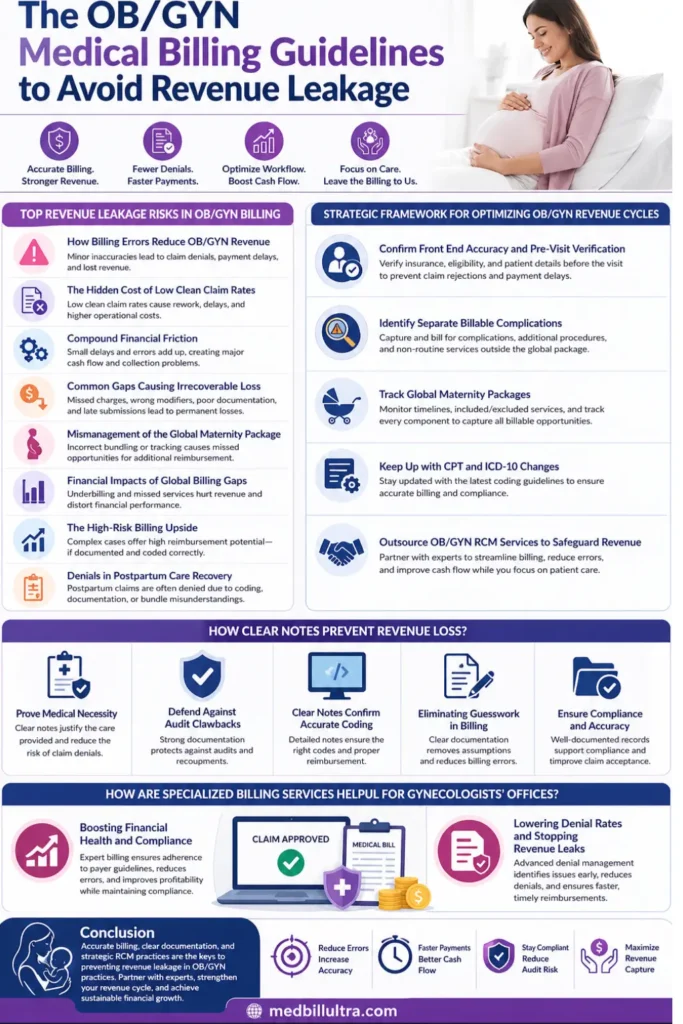
Identify Separate Billable Complications
Not all services are included in the global maternity package. Complications, additional procedures, and non-routine visits may qualify for separate billing. Identifying these services requires a thorough understanding of payer guidelines and careful documentation. Practices that consistently capture and bill for these services can significantly increase revenue while maintaining compliance.
Track Global Maternity Packages
Effective tracking of global maternity packages is essential for accurate billing. This includes monitoring the timeline of services, identifying included and excluded procedures, and confirming that all billable services are captured. Using specialized software or tracking systems can help practices manage this process more efficiently. Proper tracking not only reduces errors but also confirms that no revenue opportunities are missed.
Keep Up with CPT and ICD-10 Changes
Medical coding is constantly evolving, with updates to CPT and ICD-10 codes occurring regularly. Staying up to date with these changes is critical for accurate billing and compliance. Failure to use the correct codes can result in claim denials and lost revenue. Practices should invest in ongoing training and resources to confirm that their staff is knowledgeable about the latest coding guidelines.
Outsource OB/GYN RCM Services to Safeguard Revenue
Outsourcing revenue cycle management (RCM) services can be a strategic decision for OB/GYN practices. Specialized RCM providers have the expertise and resources to handle complex billing processes, reduce errors, and improve efficiency. By outsourcing, practices can focus on patient care while confirming that their billing processes are managed effectively. This approach can lead to higher clean claim rates, faster reimbursements, and reduced administrative burden.
How Clear Notes Prevent Revenue Loss?
Clear and detailed clinical documentation is the foundation of accurate billing. Without proper notes, coders and billers may struggle to determine the correct codes, leading to errors and denials. Clear notes confirm that all services provided are accurately captured and billed. They also support compliance and reduce the risk of audits.
Prove Medical Necessity
Medical necessity is a key factor in claim approval. Payers require documentation that justifies the services provided. Clear and detailed notes help establish medical necessity, reducing the likelihood of denials. Practices must confirm that all documentation aligns with payer requirements and accurately reflects the patient’s condition and treatment.
Defend Against Audit Clawbacks
Audits are a common occurrence in healthcare billing, and inadequate documentation can lead to clawbacks of previously paid claims. Clear notes provide a strong defense against audits by demonstrating compliance and accuracy. Practices that maintain thorough documentation are better equipped to handle audits and protect their revenue.
Clear Notes Confirm Accurate Coding
Accurate coding depends on the quality of documentation. Clear notes provide the information needed to assign the correct codes, reducing the risk of errors. This not only improves claim acceptance rates but also confirms that practices receive appropriate reimbursement for their services.
Eliminating Guesswork in Billing
When documentation is unclear, billers are forced to make assumptions, increasing the risk of errors. Clear notes eliminate guesswork, providing a reliable basis for coding and billing. This improves accuracy, reduces denials, and enhances overall efficiency.
How are Specialized Billing Services Helpful for Gynecologists' Offices?
Specialized billing services are designed to address the unique challenges of OB/GYN practices. These services offer expertise in coding, billing, and compliance, confirming that all processes are handled accurately and efficiently. By leveraging specialized services, practices can reduce errors, improve revenue capture, and streamline their operations.
Boosting Financial Health and Compliance
Effective billing practices are essential for maintaining financial health and compliance. Specialized billing services help practices adhere to payer guidelines, reduce errors, and optimize revenue. This not only improves profitability but also confirms that practices operate within regulatory requirements.
Lowering Denial Rates and Stopping Revenue Leaks
Denial management is a critical component of revenue cycle optimization. Specialized billing services use advanced tools and strategies to identify and address the root causes of denials. By reducing denial rates, practices can stop revenue leaks and improve cash flow. This proactive approach confirms that all claims are processed efficiently and accurately.
Conclusion
OB/GYN medical billing is a complex and dynamic process that requires precision, expertise, and continuous improvement. From managing global maternity packages to confirming accurate documentation, every step of the revenue cycle plays a crucial role in preventing revenue leakage. By implementing strategic frameworks, leveraging specialized services, and maintaining clear documentation, practices can optimize their billing processes and achieve sustainable financial growth.

Higher Approvals, Faster Payouts: Specialized Chiropractic Billing

Error-Free Pediatric Billing: Maximize Practice Reimbursements
You Might Also Like

Higher Approvals, Faster Payouts: Specialized Chiropractic Billing

Error-Free Pediatric Billing: Maximize Practice Reimbursements